Biofloral · Creator adUGC-001 / 9:16
Ogamama / The video ad kitchen / Open since 2026
We cook the best
product videos
on the internet.
We turn the product photography you already own into the video every sales channel now expects. Per SKU, across the catalogue.
One SKU in. One finished cut back within two business days, before anything is signed.
24h rush cut
Fixed monthly scope
Rights transferred
Month to month
Tupperware · Tumbler on the goUGC-004 / 9:16
Tupperware · Hot and coldPCK-001 / 9:16
Twinings · Herbal infusionPCK-002 / 16:9
Biofloral · Kids gummiesPCK-005 / 9:16
Spirits · Brand filmADS-004 / 9:16
Today’s service, straight off the pass. Every plate above started as a product photograph.
01 / For agenciesWe cook. You serve.White-label under your name. You keep the client, the invoice and the margin. We never leave the kitchen.
02 / For brands and sellersMore revenue, same traffic.Catalogue film on the product page, UGC style stories under the buy button. Six industries, six channels, one origin file.
Shopify product pagesMeta retargetingGoogle ShoppingAmazon listing videoA+ contentSponsored Brands VideoTikTok in-feedTikTok ShopSeasonal re-cutsWhite-label
Cooked for






Stories, straight off the pass
Tap one. This is the format that runs under a buy button, in a feed, or in a stories widget on a product page.
Get this on your product page
Every one of these started as a product photograph. Same files, delivered in the format your stories app, Instagram and TikTok expect.
01 / Why now
Every platform you sell on
has already moved to video.
Not an opinion. Five platforms, five figures, five sources you can open.
Amazon
17.7x
More clicks for video than for a static image, measured across fifteen countries. Sponsored Products campaigns with video also show +67% CTR and +9% conversion.
Amazon Science, Journal of Marketing Analytics, 2023 / Amazon Ads internal, US, 202630 June 2026
Since that date Google Shopping serves the product video you submit in Merchant Center. In Performance Max, if you do not supply video in three orientations, Google generates it for you.
Google Merchant Center and Google Ads documentation, 2026Meta
-45%
Conversion likelihood by the fourth repeat exposure to the same creative, decaying from the first repeat with no warm-up phase. Reels now carries more than half of Instagram ads.
Analytics at Meta, 2023 / Sensor Tower via CNBC, 2026TikTok
50%
Half of TikTok Shop revenue in the United States comes through in-feed video, ahead of the shop tab and live selling. US GMV grew 68% in 2025.
Momentum Works and Tabcut, February 2026Retail media
72%
Of retail media advertisers name video as one of their main off-site line items, on a channel worth $71.1bn in the United States in 2026 and EUR 13.7bn in Europe.
eMarketer, January 2026 / IAB Europe, October 202502 / Where it ships
One catalogue in.
Every surface out.
Same product photography, same production line, different jobs. A product page has to answer a question. A retargeting ad has to be different every time. A TikTok has to earn three seconds. Ordering by format makes you guess which one you need. Ordering by what you sell, and by where it runs, does not.
By industry
What the film has to prove depends on what you sell
Ecommerce, consumer goods, beauty, supplements, home and tableware, real estate. A bowl has to show its size, a serum its texture.
See the industries →Marketplaces
The listing sells alone. Give it something to show
Listing video, A+ modules, Sponsored Brands Video and Brand Story, encoded to clear on the first upload.
What ships →By channel
Six surfaces that disagree on every specification
Meta, Google Shopping, TikTok, retail screens and DOOH. Same origin file, six briefs, six encodings.
See the channels →Formats are the how: UGC, unboxing, demo, 360 turntable, macro, seasonal re-cut. The channels above are the where.
03 / The bottleneck
Creative is the last lever.
And you cannot feed it.
Targeting was taken away. What decides an account now is how many distinct assets you can put into the auction, and that number is capped by production, not by budget.
49%
Of the incremental sales a campaign generates come from the creative. Targeting accounts for 11%. NCSolutions, 450 campaigns.
5%
Of creatives ever become winners, and they absorb 55% of the spend. Motion, 578,750 creatives, $1.29bn.
59.5%
Of marketers name creative production as their main bottleneck. EMARKETER with Perion, April 2026.
04 / The recipe
One photograph in.
A year of creative out.
Every brand already owns the asset that matters: a clean photograph of the product. That single file is enough to produce a testimonial, an unboxing, a demo, a 360 turntable, a seasonal re-cut and eleven localised variants. Each one a different film, all of them the same SKU, all of them on brand.
That is the difference between commissioning a shoot and running a service. A shoot gives you one asset and a bill. A kitchen gives you a testing cycle.
How catalogue production worksOne SKU / two films
Cut APCK-006 / 9:16
Cut BADS-002 / 9:16
One SKU / two films
Cut AADS-001 / 9:16
Cut BADS-004 / 9:16
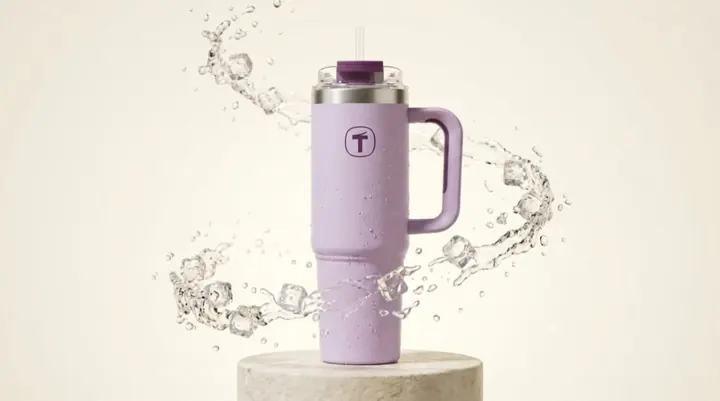
In / one product photograph
Out / four seasons, same SKU
SummerCold, 48 hours
Back to schoolSeptember desk
ChristmasGifting
JanuaryHydration reset
05 / Today’s service
Not a showreel.
A service log.
Biofloral · Creator adUGC-001 / 9:16
Biofloral · Creator adUGC-002 / 9:16
Biofloral · Creator adUGC-003 / 9:16
Tupperware · Tumbler on the goUGC-004 / 9:16
Tupperware · Insulated tumblerUGC-005 / 9:16
Fashion · Try-onUGC-006 / 9:16
Tupperware · Silicone bagUGC-007 / 9:16
Tupperware · ChopperUGC-008 / 9:16
Tupperware · Hot and coldPCK-001 / 9:16
Biofloral · Kids gummiesPCK-005 / 9:16
Grocery · Range reelPCK-006 / 9:16
Pet food · Brand filmADS-001 / 9:16
Pet care · Range reelADS-002 / 9:16
Tupperware · Tumbler macroADS-003 / 9:16
Roll 02 / 16:9 wide
Twinings · Herbal infusionPCK-002 / 16:9
Twinings · Range wallPCK-003 / 16:9
Twinings · Evening ritualPCK-004 / 16:9
Most feed video is watched muted, so every cut ships with burned captions and is legible with the sound off.
06 / The menu
Eight dishes.
Named, scoped, repeatable.
You do not brief a mood. You order off a menu, we cook at volume, and your media buyer finds out which dishes people come back for.
07 / How the kitchen runs
Four steps. Fixed service times.
01
Send what you already have
Product photos, packshots, a listing URL. No shoot, no samples shipped, no calendar.
Day 002
Scripts and concepts, in writing
Hooks, formats and angles per SKU. You approve before anything renders.
Day 1-203
Production, then human QA
Every cut is reviewed for brand accuracy, label fidelity and platform compliance before it reaches you.
Day 3-504
Delivery in every ratio, then iteration
9:16, 1:1, 16:9, with captions and localised text. We re-cut monthly against what your data says worked.
Day 5, then monthly08 / Honestly compared
Three ways to get video.
Only one runs a service.
| Creator / UGC agency | Self-serve AI tool | Ogamama | |
|---|---|---|---|
| What you are buying | One asset per brief | Generation capacity | A finished service |
| Turnaround | 10 - 21 days | Same day, then hours of fixing | 5 business days |
| Volume per month | 5 - 15 | Unlimited, uncurated | 10 - 200+ |
| Who does the work | You brief, chase and edit | You. All of it. | A studio team |
| Brand and label accuracy | Depends on the creator | No control | Human QA on every cut |
| Usage rights | Licensed per period, renewals | Platform terms apply | Full transfer, masters included |
| Markets and languages | One creator, one language | Machine translation | Any market, localised text |
| Commitment | Per campaign | Monthly seat | Month to month |
Creator and self-serve ranges are indicative 2026 market benchmarks gathered from published vendor pages and third-party procurement data, not a claim about any named competitor. See AI UGC vs real creators for the full breakdown.
09 / What we sign
What we put in writing.
Every studio says it is fast and on brand. These are the terms we will actually sign, bounded, dated and written into the terms.
- Scripts before production. You approve hooks, formats and angles in writing before a single frame renders.
- Fixed delivery dates. Five business days for the first batch from receipt of usable photography, then a fixed monthly calendar.
- Three revision rounds on batch one, within 14 days of delivery. Human revisions, not credits.
- Full rights transfer. Finished films and masters are yours. No window, no renewal, no per-platform licence.
- Platform compliance. If an asset we delivered is rejected on a technical specification, we re-encode it at our cost, once, within 30 days of delivery.
- Month to month. No annual commitment, no minimum term.
- If you reject every cut in batch one in writing within 10 business days of the revision cycle, you do not pay for it.
10 / Before you order
The questions buyers actually ask.
Including the uncomfortable one.
Does AI-produced video actually perform on Meta and TikTok?
Meta's own published research finds the likelihood of a conversion falls by roughly 45% by the fourth repeat exposure to the same creative, and declines from the first repeat onward - there is no warm-up period. That makes the number of distinct hooks and formats you can put into a testing cycle each month the most controllable variable in the account, which is exactly what a production line delivers and a single shoot cannot.
Do we have to disclose that these ads are AI-produced?
In the EU, yes. The AI Act's transparency obligations require realistic synthetic content to be machine-readable and disclosed to viewers. In the US, an AI persona presented as a real customer is an endorsement claim under FTC guidance. We deliver every cut with the platform AI-disclosure flag pre-set, and we will not script a first-person claim your legal team has not cleared. Treat this as a legal question for your counsel, not advice from us.
Will my customers be able to tell it was not filmed?
That is the question we design against. Every cut goes through a human pass for label fidelity, packaging accuracy, hand and product physics, and platform compliance. Cuts that fail the pass are re-rendered, not shipped. If a cut does not hold up, you do not receive it.
What kinds of product does this not work well for?
Anything whose selling property is complex physical behaviour: fabric drape in motion, transparent liquids poured at speed, hinged mechanisms, and anything requiring a face and a product to interact closely for a long take. We say so before we quote rather than after we deliver - and for those we recommend a hybrid with a small live shoot.
Who are the people in the videos?
Synthetic performers, not real customers or licensed actors. They do not depict identifiable living people, and we will not reproduce a specific person's likeness without written agreement. Scripts are written as brand claims, not as sworn customer testimony.
What do you need from us to start?
Product photography you already own - packshots, lifestyle images, or simply your listing or Shopify URL. Brand guidelines if you have them. That is the entire intake. No samples shipped, no studio day, no creator casting.
Who owns the finished videos?
You do. Full transfer of the finished films and the masters, with no usage window, no renewal fee and no per-platform licence. If you stop working with us you keep every delivered master; project source files stay with the studio.
Can you produce for Amazon listings specifically?
Yes, and it is a distinct discipline. Listing video, A+ and Premium A+ modules, Brand Story and Sponsored Brands Video each carry their own duration, ratio, file size and codec requirements. We encode to Amazon's published specification so assets clear on first upload, and re-encode at our cost if one is rejected on spec.
How fast is the first delivery?
A rush cut on one SKU ships within 24 hours of receiving usable photography, which is how most first conversations start. On a batch, scripts come within two business days and the first finished cuts within five, then a fixed monthly calendar applies.
What happens if Meta or TikTok rejects the ad?
If the rejection is technical - spec, file, safe zone - we fix it at our cost. If it is a policy rejection on the claim being made, we rewrite the script once at no charge; the claim itself remains your responsibility, because only you know what your legal and regulatory position allows.
Do you work with agencies?
Yes - white-label or co-branded, your choice. You keep the client relationship and the margin, we run the production line under your brand. See the agency page.
Which markets and languages do you cover?
All of them. Localisation is a re-cut, not a re-shoot: the same film ships with a new voice, new on-screen text and market-appropriate framing. Producing for eleven markets costs a fraction of producing for one, which is the structural argument for this model.
11 / How we quote
One quote. No surprises.
Send one SKU and tell us the volume. You get a written quote and a finished sample cut before anything is signed. Month to month, no retainer, no seat licence, no usage renewals.
Start here
Judge the work, not the deck.
Most studios answer a brief with a deck and a rate card. We answer it with the film. Tell us what you sell and where you run ads, and the first thing you receive is a finished cut of your own product.
- One SKU, one finished cut, back within two business days, at no cost.
- A written production plan: formats, volumes, markets, timeline.
- No retainer, no lock-in, month to month.
No call required to see the work. The full service log is right here.